


Last year I took a three-month sabbatical. I needed rest. I was exhausted and my body had very clearly told me that I needed to stop. My only plan was to make no plans. To have no to-do lists. To fully allow myself to rest and relax. It was the beginning of summer and I wanted to savour the days, go outside and feel the sun on my face. Literally, stop and smell the roses.
I remember now how hard that was. How I kept making lists in my head, how rest was on there as one more thing I could tick off my list. My head was filled with shoulds: I should be cleaning, I should be vacuuming, I should make a meal plan, I should go to the supermarket, I should do the washing. When all I really wanted to do was have an afternoon nap, read a silly romance novel and go for a walk.
I thought by scheduling in my rest and naming it a mini-retirement, a sabbatical, I would have the magical solution. I stopped, I rested. But it felt so wrong. My mind kept going and the whole concept of just stopping felt somehow like a moral failure. I kept thinking I owed someone something, I owed it to the universe to make this break worthwile.
I didn’t feel useful.

Today, I know that around that time, my endometriosis had made a comeback, and this was in part to blame for why I felt so exhausted. If I were a woman in the 1800s, I would have likely been diagnosed with hysteria and my symptoms blamed on a wandering uterus causing chaos. Perhaps, in the 1800s, I would then have come across Dr Silas Weir Mitchell and I would have been prescribed the Rest Cure.
You may think my three-month sabbatical sounds a lot like a Rest Cure but you would be mistaken. This Rest Cure meant enforced bed rest, complete isolation, no reading, no writing, forced feeding. Interestingly, nervous men at that time would have been prescribed outdoor activities like horse riding and hunting. Women were prescribed to stay at home, in the domestic sphere with every hint of education or expression taken away from them.
The cure, Dr Mitchell told women, was to “live as domestic a life as possible” and “never to touch pen, brush or pencil again.”1 Women were to focus on their gendered household tasks, and certainly not think too much of higher education, which would only put them at risk of nervous collapse.
So, why, I hear you think, if women were historically told to rest, then why is resting so difficult for us? Because this Rest Cure was never about restoration in the way that real rest should be. The Rest Cure, in its true essence, had a goal of containment, of returning a woman to her proper duties. The Rest Cure intended to take everything away that could liberate a woman: reading, writing, studying. The real restoration, according to Dr Mitchell, was in picking up the domestic duties as fast as possible.
Every woman who has ever been sick but kept cooking dinner and taking care of the kids is nodding her head right now.
When women entered the workforce in the 20th century, the unwritten rule was that they held on to their household tasks. They could go to work, but at home, the expectation was that they would continue doing the same tasks as before. Arlie Hochschild, an American sociologist, studied this concept of ‘the double burden’ in the 1980s.2 She found that women might sometimes work fewer hours in the workplace, but they take on a lot more hours at home doing unpaid labour.
If you think this is a thing of the past, have a look at these 2016 stats from the UN3.
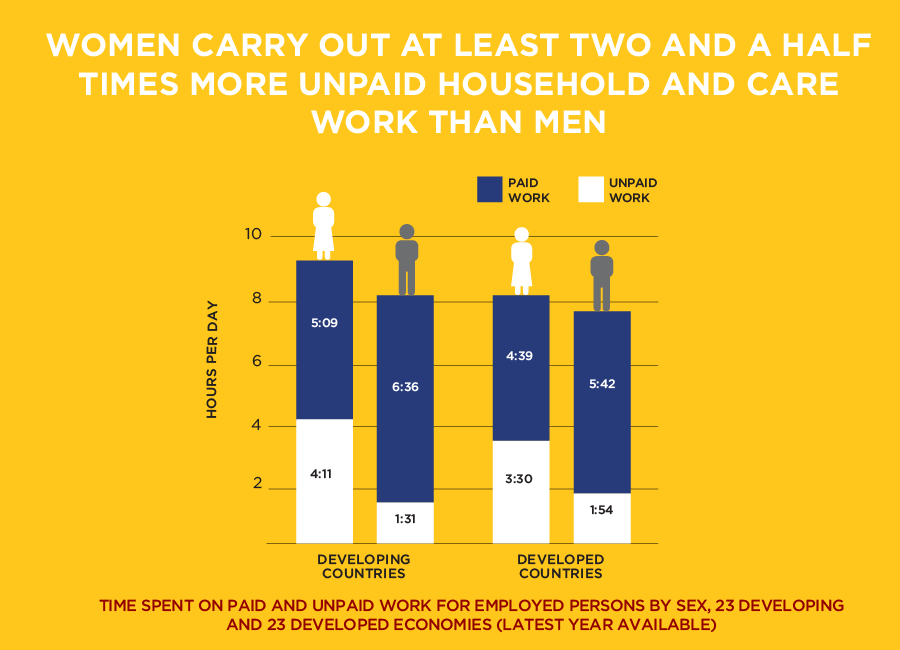
Data also found that in most countries, men have more leisure time per day than women. Go to this interesting graph to see what it looks like in your country. For my home country of Belgium the difference was about 50 minutes. My current home of New Zealand does better with only an 11 minute difference.
Then there’s the mental load that adds to what’s already on a woman’s plate. A review of 31 studies confirmed that women perform the greater share of mental labour related to unpaid domestic work and childcare, and this is associated with emotional distress, relationship dissatisfaction, and career disadvantages.4
The examples used for mental load are often related to childcare, i.e. the woman is the one who remembers all the appointments the child has. I don’t think this mental load is only restricted to people with children though, childless and childfree couples experience similar issues. It’s in the little things often. This is a terrible example if you compare it with something as massive as childcare, but just to illustrate how our brains get filled with tiny things we have to remember: this week I tried to remember every day that our parrot Croky needs his sprouted seedmix refilled. It’s his favourite food and his disappointment is noticeable when I give him his breakfast without seeds. It is now Saturday and said seedmix has not been purchased, because I have not been able to get to the shop.
Notice how I said “our” parrot, not “my” parrot, and yet it’s always been my sole responsibility to ensure the little bird is fed, happy and healthy.
In essence, the cultural message women have been receiving has always been consistent, even when it’s dressed differently: women’s rest is either dangerous (19th century), indulgent (20th century), or something to be earned (now). The implication has always been that rest is not for women.
That’s why the guilt we feel when we sit down is felt as a personal failing, but really it is the product of a long, cultural inheritance. It was built into the medical system, the domestic system, and the economic system. And, we are not alone at all. Studies show that 96% of women feel guilty about something at least once a day.5 Guilt is built into our DNA.
So when I took three months off last year with every intention to rest, relax and focus on my creativity, every inch of my body felt as if I was doing something wrong. I was also dealing with illness at the time and still, every time I lay down on the bed, all I could think about was how I should be spending my time. I was only thinking of the groceries I should be doing, the windows I should be washing, the book I should be writing.
I was the only one who cared how I was spending my time. The pressure was all mine. I had to unlearn the idea that somehow my value was conditional on the amount of tasks I completed in a day, on how useful I made myself. Slowly but surely, during those three months, I started to understand that truly resting was a worthy act in itself. That sometimes I didn’t need to do anything else but look after myself. That, if I really looked after myself, I was more able to be present for everyone else.
Resting and allowing time for myself will always be a work in progress. I have gotten much better and I truly understand the value of it now. Now, I can sit back and relax when there are still many other tasks that should be completed. I can allow myself to take some time to breathe.
When did you last rest without justifying it to yourself first? And what would it mean if you didn’t have to?
Written by: Sophie S.
Sophie is a proud member of the FLARE team and also the author of This Is Sophie Today. Her Substack focuses on reconnecting with creativity, slow living and going analog for busy professionals. Sophie has lived with Endometriosis for twenty years and wants to share her experiences with the community, to support others living with this illness.
So needed