



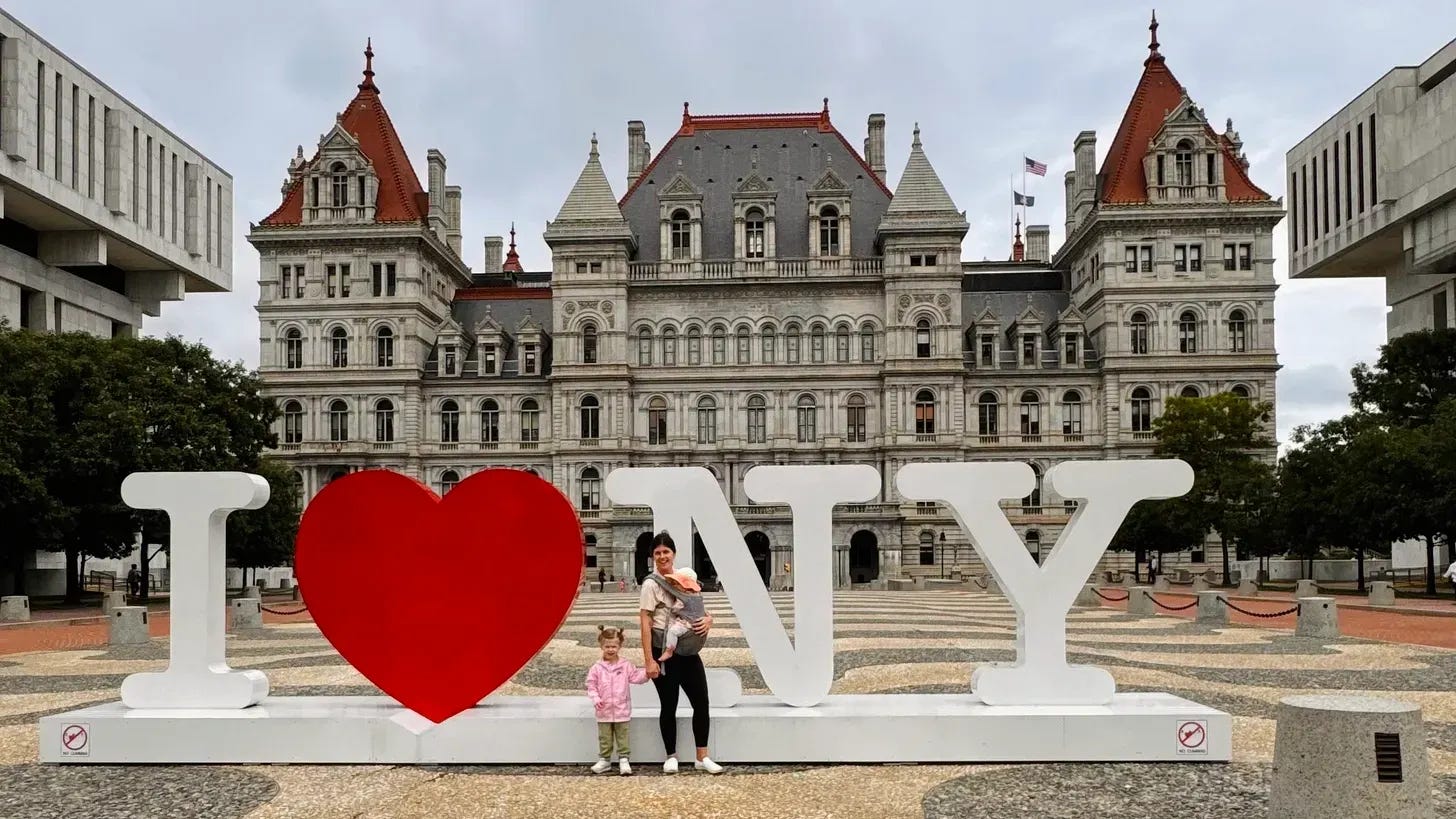
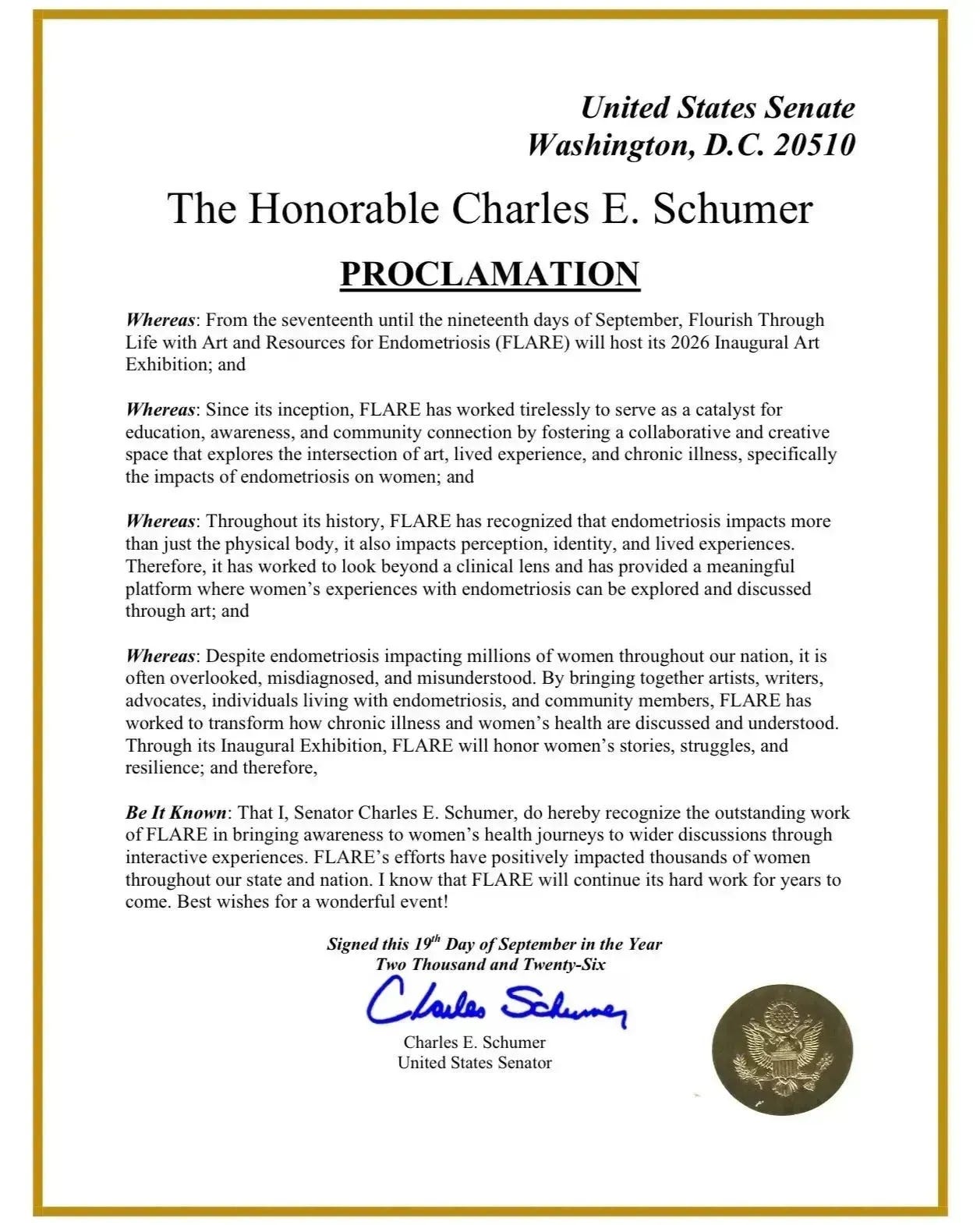
Yesterday, a document arrived from the office of United States Senator Charles Schumer, formally recognizing FLARE’s work advancing endometriosis awareness through art, education, and advocacy. It states that FLARE works “to transform how chronic illness and women’s health are discussed and understood.”
I have read that sentence a dozen times. It confirms something I have carried quietly for a long time: the experiences of people living with endometriosis are being recognized at a level that once felt out of reach.
Endometriosis has spent decades being described to healthcare professionals who did not believe or understand patients’ symptoms, dismissive employers, and exhausted friends. This disease is real enough to reshape a life, yet often invisible enough that the person living it is asked to prove it exists.
FLARE began as a quiet argument against that invisibility. Now the office of a United States Senator has formally recognized the importance of that argument.
It started without much certainty, only a strong intuition that this mission had to happen and that I was called to carry it out. On my second-to-last day in the hospital, I knew I could no longer stay silent about this disease. I wanted to take an awful, traumatizing experience—excision surgery and the treacherous years leading up to it—and turn it into something meaningful, so that one day, another person who finds themselves where I was will not have to live the same story.
I pictured a large room filled with artwork about pain that can be difficult to picture, created across different mediums by artists who, like me, have lived with endometriosis. I imagined artists gathered in conversation with people who had never asked them directly what their bodies had taught them. This vision came from the belief that art could do something clinical language alone could not: let a stranger feel, for a moment, what it is like to live inside a body the world keeps telling you is fine.
What followed has surprised me more than the initial vision ever did.
Artists have submitted work created in hospital waiting rooms and in the weeks after surgery—work that took years to become ready to share, along with pieces being created specifically for opening day. Community members have offered products, services, resources, and support, and people are planning to travel from across the country and around the world to attend. Volunteers have reached out because they believe in the impact of bringing together people whose paths were meant to cross but might not otherwise have had the opportunity or reason to connect. A few galleries said no, and some said nothing at all—but then one space said yes. Partners began to appear, first a few, then more. Piece by piece, this idea has become a reality.
The exhibition is still ahead of us, and it is the part I think about most. At its best, an exhibition is not simply a room where objects are displayed. It is an experience someone enters without knowing what they will feel and leaves changed in some small, specific way. That kind of experience is built through hundreds of decisions that have nothing to do with hanging paintings on walls.
It gets built out of the room itself: temporary walls, display systems, and lighting that lets a difficult piece breathe without overwhelming the person standing in front of it. When paintings by KYRIANNA and Prajakta hang beside a sculpture by Chelsea Hardesty and a photograph by Racheli Aye, the space between them must hold each work with care without allowing one to overwhelm another. That is the work of a Gallery Design partner, and it is closer to architecture than decoration.
It gets built out of understanding, too. Endometriosis is a chronic, systemic inflammatory disease—not simply a period or fertility condition. It is characterized by tissue similar to, but biologically distinct from, the lining of the uterus. The disease may involve multiple organs and body systems, and its symptoms and presentation vary widely. Many visitors may arrive knowing little about endometriosis beyond its name, while others will enter carrying years of lived or professional experience. Translating complex evidence into language a teenager and a physician can both understand, funding accessibility that lets more people through the door, and carrying the conversation into panels and public programming: that is the ground a Community Impact & Education partner stands on.
Above all, it gets built out of the artists. The people whose work fills these rooms are handing over some of the rawest material of their lives and trusting a stranger walking through a gallery to receive it with care. That trust has to be earned back in transportation, handling, insurance, and the kind of support that lets someone stand next to their own work at an opening without feeling like they’re on display themselves. That is what an Artist Champion partner protects.
And the experience doesn’t end at the door. There’s a welcome extension, an opening evening where visitors feel met rather than processed, wellness programming and hospitality that let art, reflection, and community sit comfortably in the same room. There’s Flourish Through the Fire, my creative wellness journal, which will find its way into waiting rooms and community centers long after the exhibition closes, carrying the conversation to people who will never see the gallery in person. A Wellness & Experience partner shapes the first. A great many hands, some of them simply Friends of FLARE, help carry the second.
That mosaic has already begun to take shape. Savvy Custom Swag is providing extraordinary in-kind product and professional-service support. Endo Excision for All is serving as FLARE’s fiscal sponsor. Our Daughters Foundation became our first financial supporter and is sponsoring the commemorative exhibition book. iCareBetter is contributing financial support while helping connect the community with trusted education, resources, and specialist information. Other partners are offering services, products, knowledge, promotion, and community connections.
No single act of generosity covers all of this. It’s closer to a mosaic, where the whole only comes into focus once enough of the pieces are in place. Some organizations will recognize themselves in the walls and the lighting. Some will see their place in the research and the wall text, others in the artists’ insurance and transportation, others in the reception that welcomes a stranger for the first time. Some will offer what they already do well, printing, design, technology, media, hospitality, as in-kind partners. Some will simply help FLARE reach a room it couldn’t have reached alone. Individuals, small businesses, healthcare systems, universities, foundations, wellness brands, design firms, hospitals, museums: none of them look alike, and none of them need to.
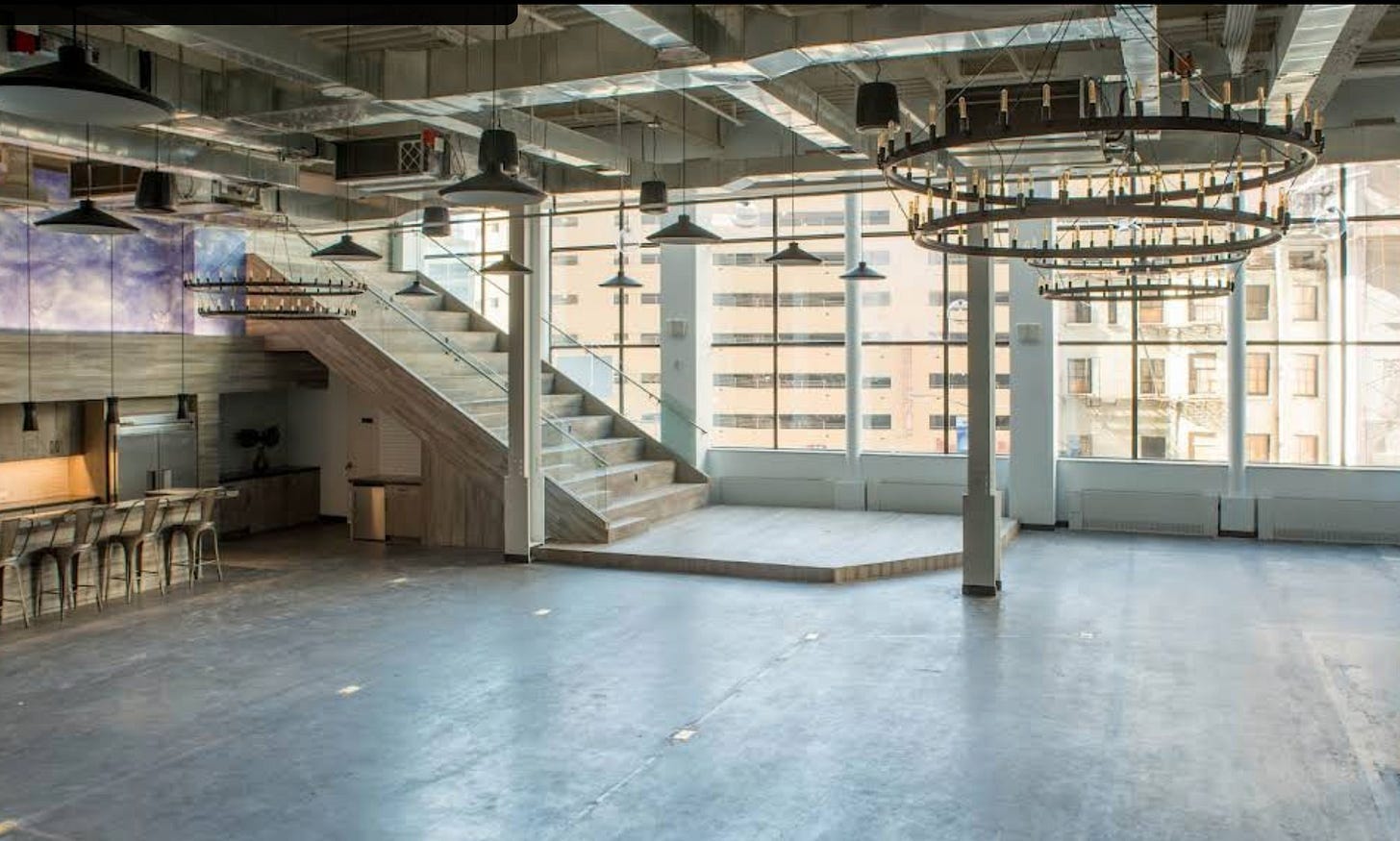
The exhibition opens September 17 through 19, 2026, at The Mezzanine, 55 Broadway, in New York City. The rooms are being imagined right now, and some of the artists are finishing the work that will hang in them.
FLARE is currently selecting a limited group of lead partners across gallery design, artist support, community impact and education, the visitor experience, and general founding support. If you read something above and thought, quietly, I know how to help with that, I would welcome the chance to shape a partnership around what your organization already does well.
Complete the FLARE Partnership Interest Form, contact us at flare.artproject@gmail.com, or learn more at flareendo.org.
For evidence-informed background on the disease and the language that shapes public understanding, read Chelsea Hardesty’s “Endometriosis 101: A Comprehensive Guide to Understanding the Disease Beyond the Basics”.
This work deserves to exist. Thank you for believing that too.
With gratitude,
Priscilla Smith
FLARE Founder & Creative Director